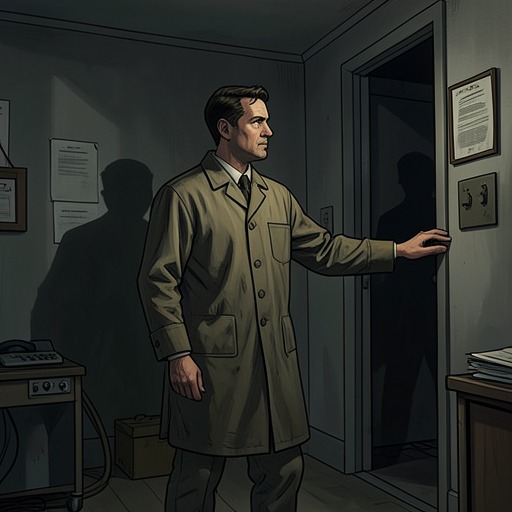
Warden
Kiss of the Spider WomanThe Warden is the prison authority who manages Molina’s possible release while trying to make him an informant against Valentin Arregui Paz. His role is defined less by personal background than by the negotiations he conducts: he presents parole as a reward for useful information, promises protection outside prison, and arranges Molina’s movements to serve an intelligence operation. The eventual announcement that Molina will be paroled, despite his failure to provide information, complicates the Warden’s earlier use of release as pressure.
Position and Institutional Role
The Warden appears as a senior official with authority over prisoners’ placement and parole, and with access to someone he calls his superior. His telephone conversation with that superior makes clear that Molina’s possible transfer is not simply an administrative matter. The Warden says Arregui has been given the impression that Molina may soon be moved because parole has been recommended. The appearance of a routine prison decision is thus part of a plan to influence what Arregui expects and how he might respond.
The Warden’s attention is directed toward information that could help the authorities act against Arregui’s organization. He asks what should happen if Molina has nothing to pass on and is told that there is little time to lose. The timing is deliberately discussed: action should not be taken that day, so Arregui has time to plan, while a message from him could allow the authorities to follow Molina to the organization. The Warden also recognizes the operational risk that Molina must not realize he is being followed. His authority therefore extends beyond the cell: he participates in a surveillance plan designed to use a prisoner’s relationships and movements as a route to others.
Parole as Leverage
When the Warden meets Molina, he first asks whether he has obtained anything from Arregui. Molina says he has not. The Warden then discloses that papers for Molina’s parole have already been prepared and that only his signature remains. He presents this near-completion as conditional leverage, emphasizing that even a minimal clue could justify signing the papers. The possibility of release is made to seem close enough to grasp, but still dependent on cooperation.
The Warden’s appeal is both practical and personal. He asks Molina to think of his mother and of the happiness his release could bring her. He also promises that the authorities will protect him after he leaves prison, specifying round-the-clock protection and assuring him that he will be safe from reprisals. These assurances are promises, not evidence that protection is ultimately provided. Molina, for his part, says that leaving prison would be enough for him, but refuses to invent information. He describes Arregui as closed and suspicious, making clear that the lack of intelligence is not simply a matter of withholding a known message.
The exchange exposes the Warden’s method: inducement, reassurance, and pressure are used together. His humane language about shared humanity and family sits beside the institutional bargain he is offering. Molina’s release is treated not only as a legal outcome but as an instrument in an effort to obtain intelligence.
Separation and the Change of Plan
When Molina still has nothing to report, the Warden says he has already done enough to help the authorities and that he will be moved to another cell. Molina pleads not to be separated from Arregui, explaining that he still hopes Arregui may eventually tell him something. The Warden notices this attachment and questions why Molina would prefer to remain with someone who speaks so little. The moment shows that Molina’s connection to Arregui has become important enough to resist the Warden’s arrangements, even though it has not yielded the information the authorities wanted.
The Warden first insists on the cell move and tells Molina to have his belongings ready. He then clarifies that Molina is to be paroled the following morning. This announcement follows the earlier presentation of release as conditional on information, although Molina has provided none. The shift leaves the Warden’s motives and the authorities’ next steps unresolved; what is established is that he controls the news and timing of Molina’s departure, while Molina’s wish not to lose contact with Arregui has not altered the intelligence plan already set in motion.
Characterization and Significance
The Warden is portrayed through administrative decisions and conversations rather than through a private life or physical description. He can make parole appear imminent, propose a cell transfer, and promise protection, but those powers operate within a larger effort to monitor and exploit communication between prisoners. His carefully managed disclosures—first presenting release as conditional, then announcing it despite Molina’s lack of information—make him an agent of institutional uncertainty as well as authority.
His dealings with Molina sharpen the contrast between personal attachment and official purpose. Molina’s hope that Arregui might confide in him is treated by the Warden as a possible intelligence channel; Molina’s reluctance to leave is consequently both an emotional response and an obstacle to the planned transfer. The Warden does not need to threaten him openly for the prison’s control over parole, placement, and protection to shape the choices available. Through this limited but consequential role, he embodies the administration’s attempt to convert a prisoner’s freedom and relationships into instruments of surveillance.